Global web icon
wikipedia.org
https://en.wikipedia.org/wiki/Randomization
Randomization - Wikipedia
Randomization is not haphazard; instead, a random process is a sequence of random variables describing a process whose outcomes do not follow a deterministic pattern but follow an evolution described by probability distributions.
Global web icon
statology.org
https://www.statology.org/randomization-in-statist…
Randomization in Statistics: Definition & Example - Statology
This tutorial provides an explanation of randomization in statistics, including a definition and several examples.
Global web icon
nih.gov
https://pmc.ncbi.nlm.nih.gov/articles/PMC5094865/
Randomization: beyond tossing a coin - PMC
Randomization is a research strategy used in order to increase the validity of clinical trials evaluating the effect of interventions (e.g., drugs or exercise).
Global web icon
numberanalytics.com
https://www.numberanalytics.com/blog/randomization…
Randomization Methods in Experimental Design
Randomization refers to the process of assigning experimental units (such as study participants, laboratory animals, or observational data points) to different groups purely by chance.
Global web icon
sciencedirect.com
https://www.sciencedirect.com/topics/nursing-and-h…
Randomization - an overview | ScienceDirect Topics
Randomization is defined as a collection of techniques used to minimize bias and confounding by ensuring that participants have an equal chance of being assigned to any treatment in a trial, thereby eliminating self-selection bias.
Global web icon
scribbr.com
https://www.scribbr.com/methodology/random-assignm…
Random Assignment in Experiments | Introduction & Examples
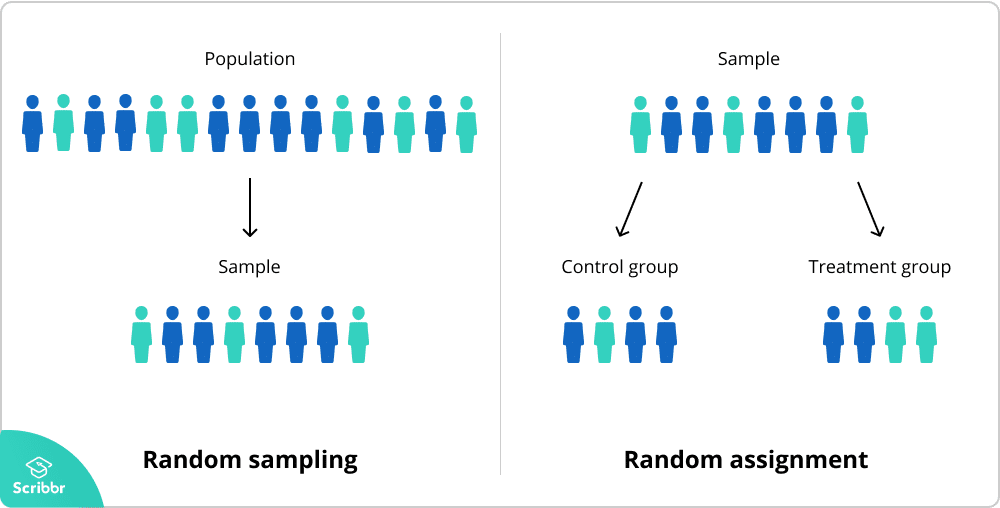
In experimental research, random assignment is a way of placing participants from your sample into different treatment groups using randomization. With simple random assignment, every member of the sample has a known or equal chance of being placed in a control group or an experimental group.
Global web icon
psu.edu
https://online.stat.psu.edu/stat509/lesson/8/8.1
8.1 - Randomization | STAT 509 - Statistics Online
Most clinical trials today invoke a procedure in which individual patients, upon entering the study, are randomized to treatment. Randomization is effective in reducing bias because it guarantees that treatment assignment will not be based on the patient's prognostic factors.